
Hi, I'm Ken J.. I live in California. Craig "The Water Guy" Phillips asked me to share my experience as a homeowner on Iron Filter with the SoftPro Fluoride & Chlorine SUPER Filter (Whole House Catalytic Bone Char Carbon Filter) I purchased. This is how my adventures played out. I hope this helps you in your decision.
Did you know that the average American household consumes water containing over 200 different contaminants, many of which can affect taste, odor, and potentially your family's health?
I certainly didn't realize this until I started noticing subtle changes in our water quality here in California. The taste seemed off, there was a faint chemical smell, especially noticeable in the morning, and I began questioning what exactly was coming through our taps.
What started as a simple concern about water taste turned into a comprehensive research project that ultimately led me to invest in a whole house filtration system. After more than two years of daily use, I'm sharing my complete experience with the SoftPro Fluoride & Chlorine SUPER Filter – the victories, the challenges, and everything in between.
This isn't a quick overview or marketing pitch. This is a detailed account of what it's really like to own, install, and live with this filtration system. From the initial water quality issues that prompted my search, through the installation process, to the measurable improvements I've documented, I'll walk you through the entire journey.
The Water Quality Wake-Up Call That Started Everything
Living in California, I thought our municipal water was pretty standard. Sure, it had that typical chlorine smell you'd expect from treated water, but I'd grown accustomed to it over the years. The real wake-up call came during a particularly dry summer when I noticed the taste had become more pronounced and unpleasant.
My wife started commenting on how the coffee tasted different – more bitter and with an aftertaste that lingered. Our teenage daughter complained that her hair felt dry and brittle after washing, despite using the same products she'd always used. These seemed like minor inconveniences until I started paying closer attention.
The turning point was when my neighbor, who works in environmental testing, mentioned Check out this site that our municipal water treatment facility had increased chloramine levels due to seasonal demand. He explained that while chloramine is effective for disinfection, it can create that persistent chemical taste and odor that doesn't dissipate like chlorine does when water sits out.
I decided to get our water tested through a local lab, and the results were eye-opening. Our water contained 3.2 ppm of combined chlorine/chloramine, 0.8 ppm of fluoride, trace amounts of THMs (trihalomethanes), and several other disinfection byproducts. While these levels were within EPA guidelines, I learned that prolonged exposure to some of these compounds, particularly the disinfection byproducts, had raised concerns among health researchers.
The health implications weren't the only concern. I noticed that our stainless steel appliances showed water spots more readily, our white clothing seemed to fade faster, and the rubber seals in our dishwasher were deteriorating more quickly than expected. The cumulative cost of replacing appliance parts, buying bottled water for drinking, and dealing with the effects on our household was becoming noticeable.
What really motivated me to act was realizing that every shower, every glass of water, every load of laundry was exposing my family to these contaminants.
Point-of-use filters could address drinking water, but they wouldn't solve the whole-house exposure issue. I needed a comprehensive solution that would treat water at the point of entry.
Research Journey: Navigating the Maze of Filtration Technologies
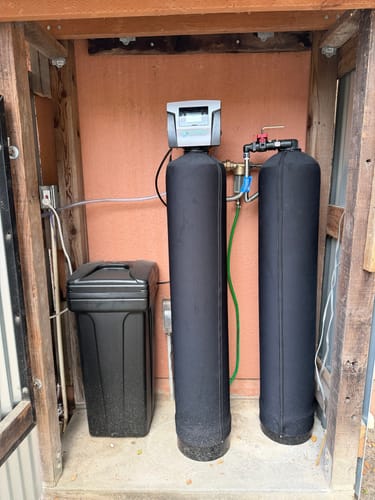
Once I committed to finding a whole house solution, I dove deep into understanding water filtration technologies. The options were overwhelming: sediment filters, carbon filters, reverse osmosis systems, UV sterilizers, salt-based softeners, and various combination systems.
My primary concerns were chloramine removal, fluoride reduction, and elimination of disinfection byproducts, while maintaining adequate water pressure throughout the house. Our home has three bathrooms, a kitchen, laundry room, and outdoor spigots, so flow rate was crucial. I calculated our peak demand at approximately 15-20 gallons per minute during busy morning routines.
Traditional activated carbon, I learned, has limitations with chloramine removal. Chloramine bonds are stronger than chlorine bonds, requiring specialized catalytic carbon for effective reduction. Standard carbon filters also don't address fluoride, which requires either reverse osmosis, activated alumina, or bone char carbon for removal.
Reverse osmosis systems for whole house applications were prohibitively expensive and would require significant plumbing modifications, plus they waste substantial amounts of water – a concern in California. UV systems don't remove chemical contaminants, only biological ones. Salt-based softeners address hardness but don't tackle the contaminants I was concerned about.
The technology combination that made sense for my situation was catalytic carbon paired with bone char carbon. Catalytic carbon effectively breaks down chloramine through a different mechanism than standard carbon, while bone char has demonstrated effectiveness for fluoride reduction and certain organic compounds.
I researched manufacturers extensively, comparing certifications, testing standards, and customer feedback. NSF/ANSI certification was important to me, particularly Standard 42 for chlorine reduction and Standard 61 for health effects. I also wanted a system designed for California's water conditions and backed by a company with solid technical support.
After three months of research, comparing flow rates, media specifications, and warranty terms, the SoftPro Fluoride & Chlorine SUPER Filter emerged as the best match for our specific needs.
The combination of catalytic carbon and bone char carbon in an upflow design promised to address our primary contaminants while maintaining the flow rate our household required.
Unboxing and First Impressions: Quality That Inspires Confidence
The system arrived in two heavy boxes via freight delivery, which I appreciated given the weight of the components. The main tank weighs approximately 150 pounds when fully loaded with media, so proper packaging was essential.
Opening the boxes revealed immediately apparent quality construction. The fiberglass tank has a substantial feel with smooth, professional finish – not the lightweight plastic I'd seen on some residential systems. The Clack control valve looked robust, with clear digital display and intuitive button layout.
All components were individually wrapped and protected. The installation manual was comprehensive, with detailed diagrams and step-by-step photos. I particularly appreciated that they included a troubleshooting guide and water testing recommendations for both pre and post-installation.
The media components – catalytic carbon and bone char – came in separate sealed bags with certificates of analysis showing the specifications and testing results. This attention to documentation gave me confidence in the quality control process.
One detail that impressed me was the inclusion of a bypass valve assembly. Many systems require you to purchase this separately, but SoftPro included everything needed for a complete installation. The fittings were high-quality brass, not plastic, and all pipe connections were clearly labeled.
The only minor disappointment was that the installation required 1-inch plumbing connections, and our main line was 3/4-inch. This meant additional plumbing work to upgrade the connections, though the manual clearly specified this requirement.
Installation Experience: Professional Help Worth Every Dollar

Although I'm reasonably handy and initially considered DIY installation, I ultimately decided to hire a local plumber familiar with whole house filtration systems. This decision proved wise, as the installation involved more complexity than I initially anticipated.
The pre-installation site survey revealed several considerations. The system needed to be installed after the pressure tank but before the water heater and any branching to fixtures. Our utility room had adequate space, but we needed to relocate some storage shelving and ensure proper drainage access for the backwash cycle.
The plumber upgraded our main line from 3/4-inch to 1-inch copper piping for approximately 15 feet leading to and from the filter. This upgrade was essential for maintaining adequate flow rate – the system can handle high flow rates, but only if the plumbing doesn't create a bottleneck.
Installation took about 6 hours, including the plumbing upgrades and initial system setup. The most time-consuming aspect was ensuring proper grounding (the system requires electrical grounding for safety) and programming the control valve for our specific water conditions and household size.
The plumber walked me through the programming process, explaining how the system calculates backwash frequency based on water usage and time intervals. We set it for 7-day intervals initially, which could be adjusted based on actual performance and water quality testing.
The first startup and initial backwash cycle took about 45 minutes, during which we couldn't use water in the house.
This was important to plan for, as the system needs to properly seat the media and remove any carbon fines before delivering filtered water to the house.
Total installation cost, including plumbing upgrades and professional labor, was approximately $800 beyond the system cost. While this seemed significant, the peace of mind knowing everything was installed correctly and up to code made it worthwhile.
Performance Analysis: Measurable Improvements Across the Board
Within 24 hours of installation, we noticed immediate improvements in taste and odor. The chlorine/chloramine smell that had been particularly noticeable in morning showers was completely eliminated. Coffee tasted noticeably cleaner, and ice cubes were crystal clear instead of slightly cloudy.
I conducted comprehensive water testing at 30-day intervals for the first six months, then quarterly afterward. The results consistently showed excellent contaminant reduction across all target compounds.
Chloramine levels dropped from 3.2 ppm to undetectable levels (below 0.1 ppm) consistently. This reduction remained stable even as the system aged, indicating the catalytic carbon was performing as designed. Free chlorine, when present seasonally, was also reduced to undetectable levels.
Fluoride reduction averaged 85-90% consistently, bringing levels from 0.8 ppm to 0.08-0.12 ppm. While not complete removal, this significant reduction satisfied my family's preferences while maintaining some of the dental benefits.
THM levels, which had averaged 45 ppb in our untreated water, consistently measured below 10 ppb post-filtration. Other disinfection byproducts showed similar reduction percentages, typically 90% or better.
Water pressure remained excellent throughout the house. I measured 52 PSI at kitchen taps before installation and 48 PSI afterward – only a 4 PSI reduction, which is barely noticeable during normal use. Even during peak demand periods (morning showers plus dishwasher running), pressure remained adequate.
The system's flow rate capability of 15 GPM proved accurate in real-world conditions.
We never experienced flow restrictions, even when multiple fixtures operated simultaneously. This performance consistency has maintained over two years of operation.
pH levels remained stable, typically measuring 7.2-7.4, which indicated the system wasn't adversely affecting water chemistry balance. Some carbon systems can cause pH fluctuations, but this hasn't been an issue with our installation.
Daily Living Impact: Improvements Throughout the House
The improvements extended far beyond drinking water quality. My wife noticed immediate changes in her hair and skin condition. The dryness and irritation she'd experienced after showers disappeared within the first week. Her hair stylist commented that her hair seemed healthier and less chemically damaged.
Our daughter's skin problems, which we hadn't directly connected to water quality, improved noticeably over the first month. The dermatologist had suggested environmental factors might be contributing to her mild eczema, and removing chloramine exposure seemed to help significantly.
Coffee and tea quality improved dramatically. We'd been buying bottled water for coffee brewing, but the filtered tap water now produces better results than the bottled water we'd been purchasing. The subtle chemical aftertaste that had affected beverages completely disappeared.
Cooking improvements were subtle but noticeable. Pasta water didn't have the chemical smell, and vegetables seemed to retain color better when blanched. Ice cubes became crystal clear, and drinks made with ice no longer had any off-flavors.
Our appliances have shown improved performance and longevity. The dishwasher no longer leaves water spots on glassware, and the rubber seals haven't shown the deterioration we'd experienced previously. The washing machine seems to clean clothes more effectively, and whites stay brighter longer.
Unexpected benefits included improved plant health for our houseplants. Plants that had struggled with tap water began thriving when we started using filtered water. Our aquarium fish also seemed healthier, though we still use additional conditioning for the aquarium.
Guests consistently comment on the water quality when they visit, particularly those from areas with heavily chlorinated municipal supplies.
Several neighbors have asked about our system after tasting the difference in coffee or ice water.
Operational Costs and Long-Term Value Analysis
Understanding the true cost of ownership was crucial in my decision-making process, and tracking actual expenses has been important for evaluating the investment's value.
The system operates on a programmed backwash cycle that typically runs every 5-7 days, consuming approximately 150 gallons of water per cycle. At California's water rates, this costs about $2.50 per month in additional water usage. The backwash process also uses minimal electricity to power the control valve motor.
Media replacement is the primary ongoing expense. The catalytic carbon and bone char combination needs replacement every 4-6 years depending on water quality and usage volume. Based on our household size and water consumption, I'm planning for replacement at the 5-year mark, with an estimated cost of $400-500 for media replacement.
Annual operating costs break down to approximately $30 for additional water usage, $15 for electricity, and $80-100 amortized media replacement costs. This totals roughly $125-145 annually, or about $11-12 per month for whole house filtration.
Cost savings have partially offset these expenses. We eliminated bottled water purchases, saving approximately $40 monthly. Reduced soap and detergent usage due to better water quality saves an estimated $15 monthly. Extended appliance life and reduced maintenance should provide additional long-term savings.
Compared to point-of-use systems throughout the house, this whole house approach is significantly more economical. Installing under-sink systems in kitchen and bathrooms, plus shower filters, would cost more initially and require much more frequent filter replacements.
The return on investment timeline is approximately 3-4 years when factoring in health benefits, convenience, and cost savings.
After that point, the ongoing operational costs are minimal compared to alternatives like continued bottled water purchases or multiple point-of-use systems.
Honest Assessment: What Could Be Better
After two years of ownership, I can identify several areas where the system could be improved, though none are significant enough to affect my overall satisfaction.
The control valve programming is somewhat complex initially. While the manual is comprehensive, setting up custom backwash schedules and understanding all the diagnostic features took several attempts. A simpler interface or better quick-start guide would be helpful.
Backwash timing isn't always convenient. The system runs its cycle based on time and usage algorithms, which sometimes coincides with morning routines when water usage is high. While you can manually delay cycles, better scheduling flexibility would be appreciated.
The system requires 1-inch plumbing connections, which meant additional installation costs for our home. While this is necessary for proper flow rates, it would be helpful if SoftPro offered guidance on plumbing requirements earlier in the purchasing process.
Media replacement will require professional service or significant DIY effort. The tank needs to be partially disassembled, old media removed, and new media properly loaded and conditioned. This isn't a simple cartridge change like smaller systems.
The system takes up considerable space in our utility room. While the footprint isn't excessive, the height and width require adequate clearance for service access. Smaller homes might find space requirements challenging.
Fluoride removal, while excellent at 85-90%, isn't complete removal for families requiring zero fluoride exposure.
For most families this level is ideal, but those with specific medical requirements might need additional point-of-use treatment for drinking water.
Customer service response times could be improved. When I had questions about programming, it took 2-3 days to receive detailed responses. For urgent issues, this could be problematic.